
Hero Mastery and Competitive Game Architecture in Mobile Legends: Controlling the Match Before It Happens
Explora Design >> Blog>> Hero Mastery and Competitive Game Architecture in Mobile Legends: Controlling the Match Before It HappensHero Mastery and Competitive Game Architecture in Mobile Legends: Controlling the Match Before It Happens
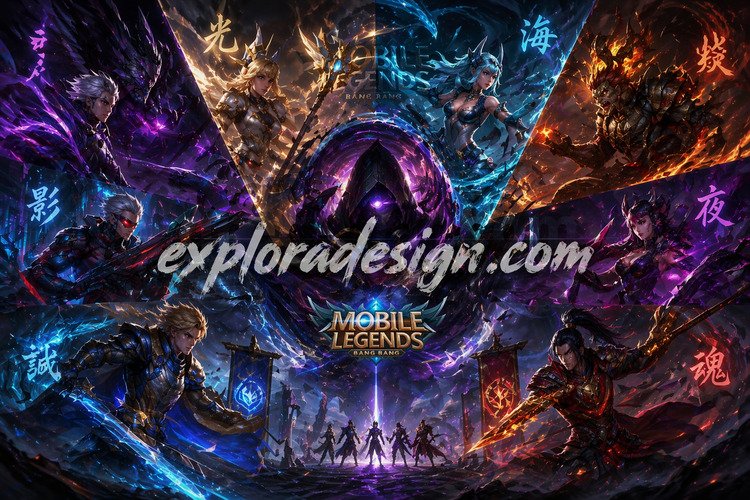
exploradesign.com – In Mobile Legends: Bang Bang, heroes are often seen as combat roles designed to execute fights, secure kills, and defend objectives. However, at a deeper competitive level, heroes are not combat units—they are components of a larger game architecture that governs information flow, map pressure, and decision constraints.
At this level of understanding, the objective is no longer to “play fights well,” but to construct a match state where the enemy has fewer and fewer correct options over time. Heroes are the tools used to build that controlled environment.
Hero Roles as Layers of Strategic Game Architecture
Each hero in Mobile Legends contributes to the match through multiple interconnected layers of control. These layers shape how the enemy moves, thinks, and reacts.
Frontline heroes function as spatial permission controllers. Tanks and durable fighters do not simply absorb damage or initiate fights—they decide which parts of the map are “allowed” for both teams.
When a frontline hero occupies key zones such as river entrances, jungle chokepoints, or objective areas, they create a permission boundary. Within this boundary, the enemy cannot safely move without risking engagement or losing vision.
This is not active fighting—it is passive control. The frontline hero essentially defines where the enemy is allowed to exist, and where they are forced to avoid. Over time, this reduces enemy map access and slows their strategic development.
Damage Heroes and Conditional Risk Projection
Damage-oriented heroes such as marksmen, mages, and assassins operate through conditional risk projection.
A marksman farming safely still pressures enemy positioning because of scaling threat. An unseen assassin creates constant uncertainty in side lanes and jungle routes. A mage controlling wave clear dictates timing across mid lane and rotation paths.
This creates a conditional risk layer where the enemy must always consider future possibilities rather than current reality. Even without direct action, damage heroes reduce enemy confidence in movement and decision-making.
Utility Heroes and Execution Fracture Systems
Utility heroes specialize in fracturing enemy execution rather than dealing damage or holding space.
A single crowd control ability can completely interrupt an initiation sequence. A shield or heal can extend engagements beyond expected outcomes. A zoning skill can delay rotations long enough to secure objectives without contest.
This creates execution fractures—moments where enemy coordination breaks apart and must be rebuilt. Over time, repeated fractures lead to disorganized gameplay and reduced strategic clarity.
Timing Architecture and Match Progression Control
Every hero in Mobile Legends operates within a timing architecture that determines when it exerts influence. Understanding this architecture allows players to control match progression rather than react to it.
Early-game heroes aim to establish initiative before scaling heroes become dominant. However, true early-game strength is not constant aggression—it is structured pressure loops.
The loop begins with wave priority. Winning wave clear grants movement priority, which leads to vision control and then decision control. This sequence forms the foundation of early-game dominance.
Strong players do not overextend this loop. Instead, they apply pressure, force responses, then reset. This ensures continuous advantage generation without exposing unnecessary risk.
Mid Game Expansion and Structural Compression Exploitation
Mid game is the phase where the map begins to compress. Outer structures fall, jungle space shrinks, and movement becomes more predictable.
At this stage, teams must convert temporary advantages into permanent control. This includes objectives, vision dominance, and territorial restriction.
Compression increases the value of coordinated pressure. By applying threats in multiple lanes or zones, teams force inefficient responses and open opportunities for structural gain.
Late Game Execution and Outcome Locking Phase
Late game compresses all decisions into a few critical outcome-defining moments.
Vision control becomes absolute. Without vision, even strong teams are vulnerable to instant collapse through hidden engagements or mispositioning.
Execution becomes deterministic. Engage timing, target prioritization, and ability sequencing must align precisely. There is no flexibility—only execution of pre-established conditions.
At this stage, a single error often determines the entire match outcome.
Hero mastery alone is not enough to ensure consistent victory. Macro systems define how heroes are deployed to construct long-term structural advantage across the map.
Wave Engineering and Forced Pathway Design
Wave management is fundamentally forced pathway design. Whoever controls waves controls where the enemy is allowed to move.
When multiple lanes are pushed simultaneously, enemy movement becomes restricted into predictable patterns. This limits their ability to contest objectives or initiate proactive plays.
These forced pathways allow teams to predict enemy movement and create strategic traps or rotations.
Objective Layering and Multi-Directional Pressure Fields
Objectives become significantly stronger when combined with simultaneous pressure from multiple directions.
Instead of focusing on a single objective, strong teams apply pressure across lanes, jungle vision, and objective zones simultaneously. This creates multi-directional pressure fields.
When the enemy cannot respond to all threats, they inevitably lose control in at least one area. That loss becomes the entry point for objective conversion or map dominance.
Win Condition Alignment and Adaptive Strategy Regulation
Every match has a win condition defined by hero composition and early-game outcomes.
Some teams are built for early aggression, others for mid-game control, and others for late-game scaling. Understanding this determines how the match should be approached strategically.
However, adaptation remains essential. Game states constantly shift due to rotations, item spikes, and unexpected pressure. Strong players regulate their strategy while maintaining structural discipline.
Conclusion Hero Mastery and Competitive Game Architecture in Mobile Legends: Controlling the Match Before It Happens
In Mobile Legends: Bang Bang, hero mastery is not defined by mechanical execution, but by understanding how heroes function as interconnected systems that control space, time, and information.
Frontline heroes control spatial permission, damage heroes generate conditional risk projection, and utility heroes fracture execution timing. When combined with macro systems such as wave engineering, objective layering, and win condition alignment, these roles form a complete competitive architecture.
At the highest level, players no longer think about winning fights—they think about constructing environments where the enemy has no favorable decisions left. At that point, heroes are no longer just characters, but instruments for designing and controlling the entire structure of the match.
Related Post
Mobile Legends Resource Management Guide: How to Maximize Gold and Experience for Stronger Match Performance
exploradesign.com - Mobile Legends: Bang Bang rewards players who know how to use their resources…