
Strategic Hero Mastery in Mobile Legends: Chaos Management, Adaptation Loops, and High-Level Game Control
Explora Design >> Blog>> Strategic Hero Mastery in Mobile Legends: Chaos Management, Adaptation Loops, and High-Level Game ControlStrategic Hero Mastery in Mobile Legends: Chaos Management, Adaptation Loops, and High-Level Game Control
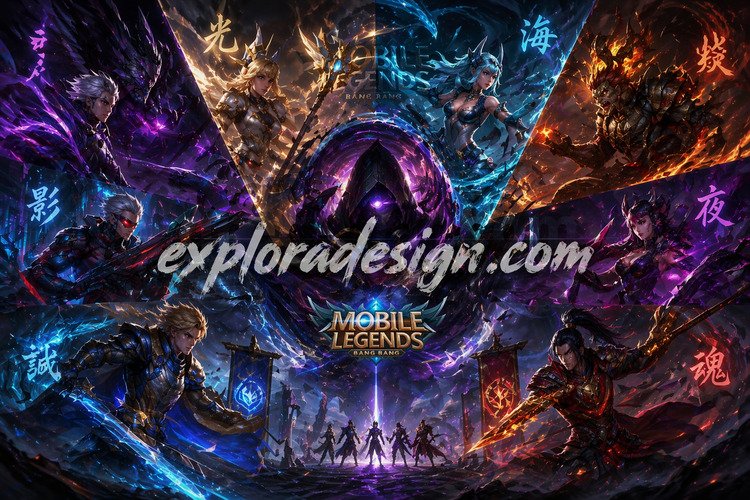
exploradesign.com – In the competitive environment of Mobile Legends: Bang Bang, mastery over heroes is not just about understanding roles or executing combos. At an advanced level, the game becomes a system of controlled chaos where players must continuously adapt to unpredictable variables while still maintaining structure, discipline, and strategic clarity.
What separates consistent winners from average players is not mechanical speed alone, but the ability to interpret chaos, stabilize it, and convert it into controlled advantage. Every hero becomes part of an adaptation loop—reacting, adjusting, and re-establishing dominance across shifting game states.
Chaos Management and Controlled Decision-Making Under Pressure
Every match contains chaos: unexpected ganks, failed rotations, mispositioned teammates, and unpredictable enemy aggression. High-level players do not avoid chaos—they manage it.
Team fights in Mobile Legends rarely unfold perfectly. Skills are missed, positions break, and unexpected engages happen. Controlled chaos theory is about maintaining structure even when execution is imperfect.
Instead of panicking, experienced players identify priority threats and stabilize their positioning. Tanks absorb pressure, damage dealers reposition, and supports reset vision control. Even in disorganized fights, structure can still be rebuilt through discipline.
The key is not perfect execution, but controlled response under imperfect conditions.
Emergency Decision Trees and Instant Adaptation
In fast-paced situations, players rely on decision trees—pre-learned responses to common scenarios. For example, if an assassin appears, the backline immediately shifts positioning; if a lane collapses, rotations are triggered instantly.
These decision trees reduce cognitive overload and allow faster reactions without hesitation. They are especially important in high-pressure situations where overthinking leads to mistakes.
Elite players build these mental frameworks through repetition and game experience.
Stability Anchors and Role Responsibility Hierarchies
Every team needs stability anchors—heroes or players responsible for maintaining structure when chaos breaks out. Tanks often fulfill this role, but sometimes mid laners or junglers also act as stabilizers depending on composition.
These anchors ensure that even when fights become disorganized, the team does not fully collapse. They reset positioning, control vision, and re-establish engagement structure.
Without stability anchors, teams tend to overcommit or scatter during pressure situations.
Adaptation Loops and Continuous Strategy Evolution
Adaptation is not a single decision—it is a continuous loop of observation, reaction, and adjustment. In Mobile Legends, this loop happens constantly throughout the match.
Every lane outcome influences global strategy. A winning lane creates rotation freedom, while a losing lane forces defensive adjustments.
These feedback loops require constant awareness. If a lane is losing heavily, other lanes must reduce risk and avoid overextension. If a lane is winning, pressure must be increased to accelerate advantage conversion.
Ignoring these loops leads to disconnected gameplay where individual lanes act independently instead of as a unified system.
Adaptive Hero Function Shifting Mid-Game
Heroes are not fixed in their roles after drafting. A fighter may become a secondary initiator, a mage may transition into zoning control, and a marksman may shift into siege responsibility.
This function shifting happens naturally based on item progression and game state. The strongest players recognize when their hero’s role has changed and adjust their playstyle accordingly.
Failure to adapt leads to inefficiency, even if the hero is theoretically strong.
Meta Drift and Situational Power Recalibration
Meta is not static—it shifts even within a single match depending on economy, objectives, and tempo.
A hero that is strong early may lose influence if the game slows down. Conversely, scaling heroes may become dominant if the match extends unexpectedly.
Situational recalibration means constantly reassessing hero value based on current conditions rather than pre-game assumptions.
Game control is the ability to dictate how the match is played rather than reacting to it. This is achieved through structure, vision, and disciplined execution.
Controlled Engagement Zones and Fight Engineering
High-level teams do not fight randomly. They engineer engagements in specific zones where they have advantage—near objectives, in vision control areas, or in narrow jungle paths.
These controlled zones reduce enemy flexibility and increase the likelihood of favorable outcomes. Fighting outside of these zones is avoided unless necessary.
This transforms fights from chaotic encounters into structured executions.
Resource Starvation and Economic Pressure Systems
One of the most effective control strategies is denying enemy resources. This includes jungle camps, lane minions, and objective timers.
When enemies lose access to resources, their item progression slows down, reducing their ability to contest fights effectively. Over time, this creates an irreversible advantage.
Economic pressure is often invisible but extremely impactful in long matches.
End-State Mapping and Victory Path Visualization
End-state mapping is the ability to visualize how the game will end based on current advantages. This includes predicting when towers will fall, when objectives can be secured, and how enemy defenses will collapse.
Players who understand end-state mapping make fewer unnecessary risks because they always know what the next step toward victory is.
This clarity prevents chaotic decision-making in late-game scenarios.
Conclusion Strategic Hero Mastery in Mobile Legends: Chaos Management, Adaptation Loops, and High-Level Game Control
In Mobile Legends: Bang Bang, hero mastery reaches its highest level when players can manage chaos, operate within adaptation loops, and maintain structural control over the entire match.
Instead of being overwhelmed by unpredictable situations, elite players learn to stabilize them. Instead of sticking to fixed roles, they adapt dynamically to game state changes. And instead of reacting blindly, they shape the flow of the game through controlled decision-making.
True mastery is not about eliminating chaos—it is about transforming chaos into structured advantage until victory becomes the natural outcome of consistent control.
Related Post
How to Play Mobile Legends: Turning Defensive Cooldowns Into Winning Counterplay Opportunities
Understanding Defensive Abilities and Their Impact on Combat Decisions exploradesign.com - In Mobile Legends: Bang…