
Mobile Legends Hero Mastery: Universal Game Theory Application, Perfect Information Simulation, and Strategic Reality Shaping
Explora Design >> Blog>> Mobile Legends Hero Mastery: Universal Game Theory Application, Perfect Information Simulation, and Strategic Reality ShapingMobile Legends Hero Mastery: Universal Game Theory Application, Perfect Information Simulation, and Strategic Reality Shaping
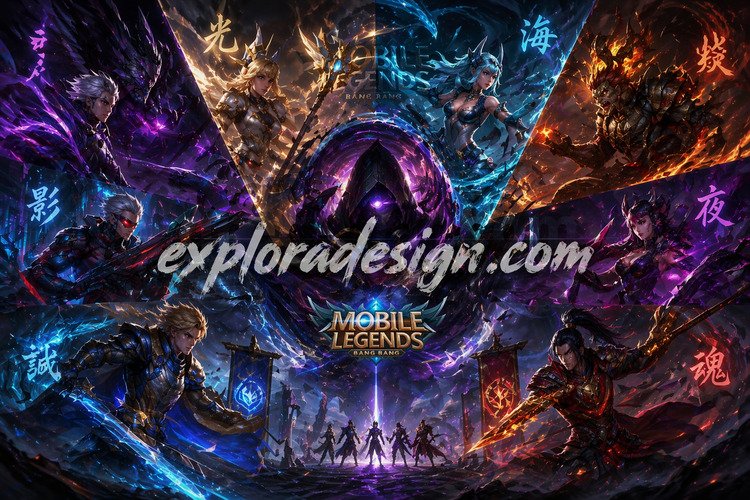
exploradesign.com – Mobile Legends: Bang Bang, at its deepest theoretical layer, stops being a traditional competitive game and becomes a structured simulation of imperfect information, controlled pressure systems, and adaptive decision networks. Heroes are not individual power units anymore—they are functional variables inside a dynamic equation where every action changes the probability of future outcomes.
At this level, mastery is not about reacting to the game as it happens, but about shaping what the game is allowed to become.
Universal Game Theory Application in Competitive Mobile Legends
Game theory describes how rational agents make decisions under conditions of uncertainty and opposition. In Mobile Legends, every lane, rotation, and fight can be interpreted as a repeated game where both teams continuously adjust strategies based on observed behavior.
Every action in Mobile Legends creates a zero-sum shift in pressure. If one team gains map control, the other loses access to resources, vision, or movement space.
This redistribution is not always equal in value. For example, losing a small objective while gaining superior positioning can still be advantageous if it leads to future structural control.
High-level players constantly evaluate whether an exchange is temporally beneficial rather than immediately beneficial, focusing on long-term advantage curves rather than isolated outcomes.
Nash Equilibrium States and Stabilized Map Conditions
A Nash equilibrium in Mobile Legends occurs when neither team can improve their position without risking equal or greater loss. These states often appear during mid-game standoffs around objectives.
In this condition, both teams avoid unnecessary risks and rely on small optimizations such as wave control, vision probing, or cooldown tracking.
Breaking equilibrium requires introducing asymmetric pressure—such as split pushing, forced rotations, or vision collapse—to destabilize the opponent’s decision structure.
Dominant Strategy Elimination and Adaptive Counterplay Systems
A dominant strategy is a tactic that consistently yields advantage regardless of opponent response. However, in Mobile Legends, no strategy remains dominant for long because counterplay evolves rapidly.
Elite teams focus on eliminating opponent dominant strategies first rather than maximizing their own aggression. This includes banning key heroes, disrupting early rotations, or denying core farming patterns.
By removing stability from enemy strategy, teams force adaptive instability that leads to mistakes.
Perfect Information Simulation and Predictive Fog-of-War Control
Mobile Legends is fundamentally a game of imperfect information. However, advanced players simulate perfect information conditions through prediction, tracking, and controlled vision.
Even without direct vision, players can reconstruct enemy positions based on behavioral patterns such as lane clearing speed, jungle timing, and missing hero intervals.
This reconstruction creates a mental model of the entire map, allowing decisions to be made with near-perfect confidence.
At high levels, players are rarely guessing—they are calculating probabilities based on structured inference models.
Fog-of-War Manipulation and False Information Injection
Beyond gathering information, elite players also manipulate what the enemy believes. This includes fake rotations, delayed visibility, and intentional absence from expected positions.
By controlling what the enemy sees, teams can influence their decision-making in advance.
False information injection is particularly powerful because it forces opponents to commit to incorrect assumptions, leading to inefficient rotations or failed engagements.
Predictive Locking and Future State Anticipation Systems
Predictive locking refers to committing to decisions based on predicted future states rather than current conditions.
For example, rotating toward an objective before it spawns is based on anticipation of enemy movement, not visible presence.
This forward-locking behavior allows teams to arrive at advantageous positions before conflicts even begin.
At the highest level, Mobile Legends is not about responding to reality—it is about shaping it. Teams do not react to events; they design conditions that make specific outcomes inevitable.
Reality Compression Through Controlled Decision Narrowing
Reality compression is the process of reducing the number of viable enemy decisions over time. As lanes are pushed, jungle is denied, and vision is controlled, the enemy’s options shrink.
Eventually, they are forced into predictable patterns such as defending base, contesting objectives, or taking risky rotations.
Compressed reality simplifies prediction and increases control over engagements.
Outcome Channeling and Forced Engagement Pathways
Outcome channeling refers to guiding the enemy toward specific predictable outcomes, such as unfavorable fights or uncontested objectives.
This is achieved through coordinated pressure across multiple zones, making all alternative decisions inefficient or dangerous.
When executed correctly, enemies are not forced—they are guided into losing positions without realizing it.
Deterministic Victory Construction and Final System Lockdown
At the final stage, the game becomes deterministic. The winning team has eliminated enough variables that the outcome is no longer uncertain.
Final system lockdown involves controlling all lanes, securing all vision points, and synchronizing final objective pressure.
At this stage, execution is not about creativity—it is about precision. Every action follows a predefined optimal sequence that guarantees victory unless interrupted by major errors.
Conclusion Mobile Legends Hero Mastery: Universal Game Theory Application, Perfect Information Simulation, and Strategic Reality Shaping
Mobile Legends at its most advanced theoretical level becomes a system of game theory interactions, information simulation, and reality shaping mechanics. Heroes are simply tools used to manipulate probability distributions within the match environment.
Game theory explains decision conflicts. Perfect information simulation reduces uncertainty. Reality shaping transforms advantages into inevitability.
True mastery is achieved when a player no longer reacts to the game state—but instead constructs the game state in such a way that only one outcome remains possible.
Related Post
How to Improve Counter-Engage Decisions in Mobile Legends
exploradesign.com - Mobile Legends is often described as a game of initiation, but strong players…